Capital is limited. Problems are not.
Ten coupled layers across Pakistan's landscape, synthesised into one decision-grade map. We rank the specific places where one action moves many layers at once.
Intelligence layers, one convergence map
Domains · water · carbon · energy
Diagnostic · where to act, staked on reputation
When pressures converge in the same landscape, interventions stop being scattered — they start compounding. The engine produces this at two scales: atmospheric (Example 1 · Salt Range bypass, 45 years of ERA5) and district (Example 2 · Matiari, worked end-to-end). Four products deliver it (see Pricing).
No more guesswork. No more picking sites by availability or politics. When you can see where multiple pressures and opportunities overlap, every dollar, every tree, every tonne of biochar goes exactly where it does the most.
A place with high fertilizer costs, available crop residue, and declining water tables is not three problems. It is one site where biochar cuts input costs, builds soil, and restores water. The overlap is the leverage.
The same tight coupling that lets degradation cascade through a landscape can be reversed. Restore the right site and the effects travel: downstream water quality improves, adjacent farms see moisture return, the atmospheric signal shifts.
Pakistan is not short on data, money, or people who care. It is short on a view that shows where all of these meet. The crises are real. So is the opportunity hidden inside them.
Pakistan uses more water per hectare than almost any country in its income bracket. Efficiency gains in agriculture are water gains for everyone.
Farmers in high-input districts spend PKR 12,000-18,000/acre on synthetic fertilizer. Every rupee exposed to exchange rate risk and commodity swings.
Rice straw in Sindh and Punjab. Sugarcane tops in lower Punjab. Feedstock for biochar, compost, and energy, set on fire every harvest.
The same Indus floodplain that grows Pakistan's food absorbed a catastrophic flood. Recovery siting needs spatial intelligence, not guesswork.
Each layer is a spatial question with a spatial answer. Water. Carbon. Energy. Plus seven coupled inputs. Select one to read what that answer looks like, per district, per season.
Where do all seven answers point to the same coordinates?
Between the Arabian Sea and K2, Pakistan's terrain intersects five successive condensation stages. A single atmospheric variable, the lifting condensation level, decides how many are active. Across 45 years of ERA5 reanalysis, the answer is two. The other three are not blocked by geography. They are compressed by a missing land surface. That compression can be released.
Analysis based on forthcoming LandIQ / Ali Bin Shahid ESSOAr preprint — submission in progress, DOI to follow.
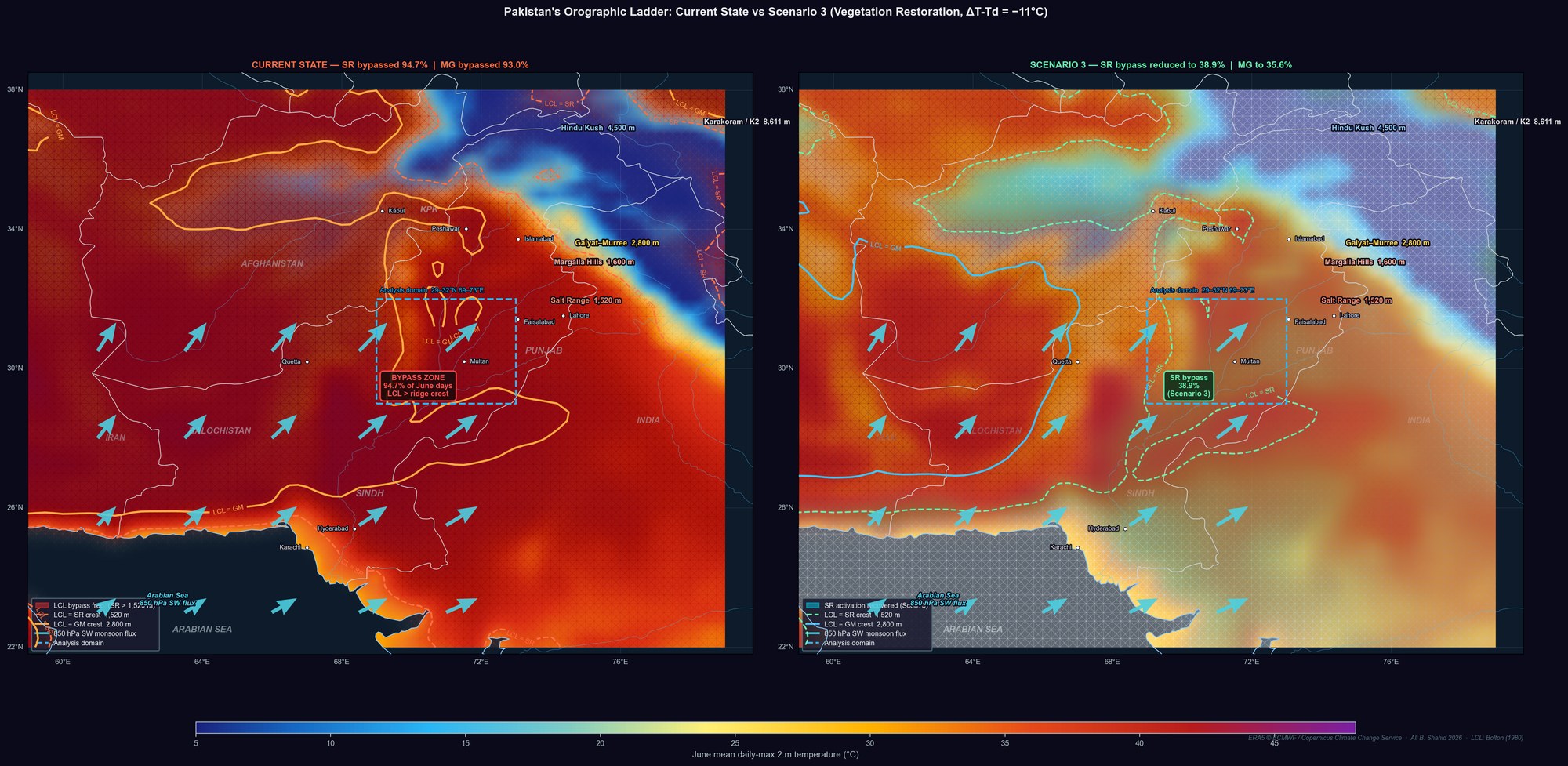
The gap between Pakistan's current water capture and its terrain-defined ceiling is the largest unrealized natural capital endowment in South Asia. Closing it is a water-security, food-security, and climate-resilience problem solved by the same intervention.
LandIQ is the only intelligence practice that couples atmospheric physics with district-level political economy across ten layers — water, biosphere, farming, feedstock, livestock, people, energy, carbon, terrain, and the convergence scenarios that synthesise them — all at district resolution, in one decision-grade map. We return a ranked set of sites where one well-placed action lifts production, earns exports, protects the country's water, and the atmosphere over it. Pakistan is where we start.
The same intelligence layer informs cloudburst response, watershed planning, and restoration targeting — executed through engagements we lead (see Ali’s track record).
Sample analysis — the output our Diagnostic tier produces for a specific decision. Not a delivered engagement.
A ~1,459 km² district in lower Sindh where six of the eight LandIQ layers converge. It sits on the Indus, anchors Pakistan's second-largest Nili-Ravi buffalo belt, grows cotton and sugarcane on the same soils, and burns ~140,000 tonnes of crop residue every October. A single well-placed intervention here cascades through water, livestock, farming, feedstock, and people at once.
One physical footprint does five jobs at once: diverts crop residue from burn to biochar, redirects dairy effluent from canal to compost, re-wets the root zone via canal repair, re-establishes shade and fodder via silvopasture, and rebuilds the Indus riparian corridor 2–3 km back from the channel.
Cascade projections use coupled hydrology + biomass + dairy models ground-truthed against PBS district data and Sindh Agriculture Facts & Figures 2024. Sensitivity bands reported in the full brief.
The same underlying intelligence — ten layers, district resolution, trigger-point ranking — resolves differently depending on what decision you’re defending. Here’s what LandIQ delivers to each kind of reader.
Bespoke and Diagnostic are available today — consult-led, scope-based. Atlas and Signals are planned subscription products, launching in 2026 as LandIQ transitions from judgment firm to platform. Founding clients contact us to join early-access cohorts.
Atlas sells you the facts — subscribe to the layers you need. Signals sells you what they mean — subscribe to pre-built convergence scenarios. Bespoke builds what you specify — a one-time custom project. Diagnostic tells you where to act — a one-time premium recommendation, reputation staked. Data spine cited across all four. On Atlas and Signals the synthesis methodology is proprietary — you buy outputs, not the engine. On Bespoke, methodology + models transfer to the client. On Diagnostic, methodology is disclosed in detail under engagement but remains LandIQ IP.
The raw intelligence stack. Subscribe to the layers your decision domain needs — Water alone for a canal authority, Carbon for a VCM funder, Energy for an IPP developer, or the full ten for a ministry. Quarterly refresh per layer, standing dashboard, GeoTIFF / GeoJSON delivery.
Pre-built convergence scenarios — the synthesis Atlas can't give you. Ranked district lists per objective, quarterly refresh, event-triggered alerts (e.g., "Matiari risk score jumped Q3 2026"). Subscribe to one scenario or a bundle that matches your decision stream.
Custom modelling, custom dataset generation, multi-year programs, embedded team. You bring the specification; we deliver to your brief. Transferable, reproducible, yours.
We run the convergence synthesis weighted for your question — where water, carbon, energy, and the seven coupled inputs point to the same districts — ground-truthed at the top candidates, delivered as a signed brief: here is where to act, what it costs, what cascades out, what could go wrong, and why we'd stake our reputation on it.
Entrepreneur with a thirty-year track record of executing first-of-kind projects in industry and capital — from a patented textile-wastewater reuse process (PK 139309, 2007) to leadership of the Indus Climate Fund in New York, directing catalytic capital into climate technology, sustainable agriculture, biochar, and carbon markets. Trustee of the Irshad Foundation for nineteen years, financing girls’ education across rural Sindh. Stony Brook University. Anchors LandIQ’s operational scale, client relationships, and long-term direction as the practice moves from consulting to platform.
Twenty years in systems engineering. A decade on coupled land–atmosphere systems. Peer-reviewed work in hydrology and thermal forcing. LandIQ is the instrument for locating where restoration carries furthest in Pakistan.
Every degraded landscape contains the map of its own recovery. The coupling that drove collapse is the same coupling that carries restoration. The question was never whether recovery is possible. It was always: where do you start?
Featured on Investing in Regenerative Agriculture as "one of the few who can model and calculate water cycle restoration."
Today, each engagement is bespoke. The pipeline that backs them becomes a product once the pipeline is proven.
Spatial intelligence assembled per-project. Satellite-based analysis, convergence reports, strategic plans, and advisory engagements across water, agriculture, and restoration.
Automated ingestion from satellite, government, and field sources. Convergence scoring validated against live deployment outcomes. Bioacoustic biodiversity layer in development.
Self-serve access. Query any district. Export convergence reports. API for MRV integration, carbon registries, and project developers.
The engine runs on ~20 open-source datasets, a selection of which is listed here — alongside proprietary sources, field-collected Pakistan data, methodology, and weightings developed in-house. Exhaustive data lineage + methodology are disclosed under engagement. Weighted-sum composites, threshold selections, field-calibration records, and in-country primary research are not published here.
We work with organizations, governments, and investors who want their next intervention to land at the site where one action carries five outcomes.
ali@landiq.earth